
I welcome the publication of the Marie Curie report, Dying in Poverty 2025.
The Report finds that one in four working age people and one in six older people still die in end-of-life poverty – a shocking outcome.
Terminal illness is a key factor and can exacerbate existing inequalities.
Terminal illness can result in higher energy and housing costs. A terminal diagnosis can force both a dying person and their carers to reduce their working hours or give up paid work entirely.
In light of the Report’s findings, I am highlighting calls for the Government to take action to prevent people from dying in end-of-life poverty
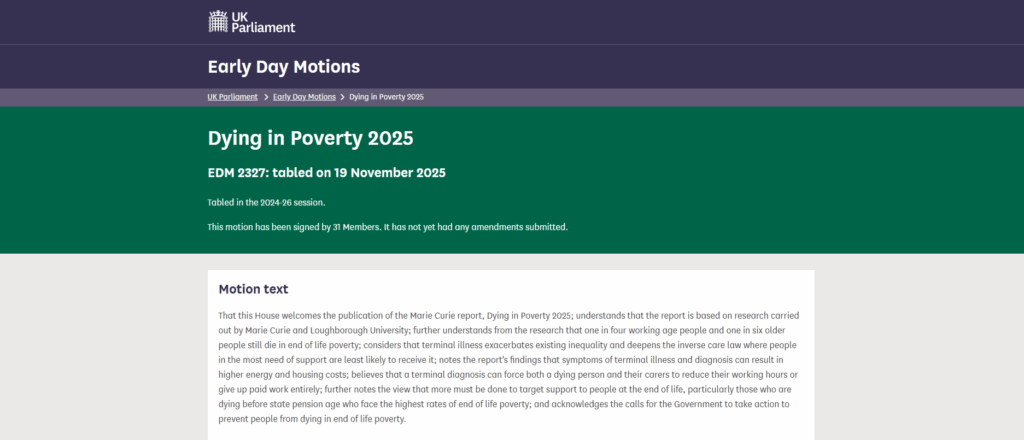
I have signed a parliamentary motion, Early Day Motion 2327, which says:
“That this House welcomes the publication of the Marie Curie report, Dying in Poverty 2025; understands that the report is based on research carried out by Marie Curie and Loughborough University; further understands from the research that one in four working age people and one in six older people still die in end of life poverty; considers that terminal illness exacerbates existing inequality and deepens the inverse care law where people in the most need of support are least likely to receive it; notes the report’s findings that symptoms of terminal illness and diagnosis can result in higher energy and housing costs; believes that a terminal diagnosis can force both a dying person and their carers to reduce their working hours or give up paid work entirely; further notes the view that more must be done to target support to people at the end of life, particularly those who are dying before state pension age who face the highest rates of end of life poverty; and acknowledges the calls for the Government to take action to prevent people from dying in end of life poverty.”
View the motion and a full list of signatories online here.
Read the report here: Marie Curie, Dying in Poverty 2025